



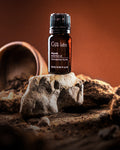

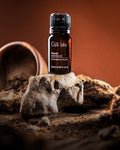
Patchouli and vetiver are both deep, earthy base notes, but they smell different. Patchouli (Pogostemon cablin), distilled from dried leaves, is rich, musky and slightly sweet, like damp forest floor. Vetiver (Chrysopogon zizanioides), distilled from the roots of a grass, is dry, smoky and rooty. Choose patchouli for warmth, vetiver for dry depth, or blend 1 drop of each for an earthy base that’s richer than either alone.
Some oils are bright and fleeting. Patchouli and vetiver are the opposite: heavy, slow and grounding, the scents that are still there hours after everything else has faded. Here’s how to tell them apart and use them well.
Patchouli vs Vetiver at a Glance
|
Feature |
Patchouli |
Vetiver |
|
Botanical name |
Pogostemon cablin |
Chrysopogon zizanioides (also sold as Vetiveria zizanioides) |
|
Plant |
Leafy herb in the mint family |
Tall clumping grass |
|
Part used |
Dried leaves |
Roots |
|
Extraction |
Steam distillation |
Steam distillation |
|
Main origins |
Indonesia (most of the world’s supply) |
Haiti, Java (Indonesia), Réunion, India |
|
Scent |
Earthy, musky, slightly sweet; hints of cocoa when aged |
Dry, smoky, woody, rooty; sometimes green or mineral |
|
Key molecule |
Patchoulol (patchouli alcohol) |
Khusimol and vetivones |
|
Texture |
Medium; pours easily |
Very thick; drips slowly |
|
Note |
Base |
Base |
|
Ages well? |
Yes, smoother and rounder over time |
Yes, softer and sweeter over time |
|
Best for |
Warm, rich, sweet earthy blends |
Dry, smoky, fresh earthy blends |
What Is Patchouli Essential Oil?
Patchouli oil is steam distilled from the dried leaves of Pogostemon cablin, a bushy herb in the mint family native to tropical Asia. Indonesia, mainly Sulawesi and Sumatra, produces an estimated 80 to 90% of the world’s supply (Indesso).
What it smells like: deep, earthy and musky, with a soft sweetness. Think damp soil and dry leaves. Well aged patchouli becomes rounder and can take on a faint cocoa note.
Why it smells that way: its signature molecule is patchoulol, typically about 26 to 34% of the oil, which gives it its woody, earthy backbone.
Gya Labs Patchouli Essential Oil is steam distilled from dried leaves, sourced from Indonesia, the Philippines and India ($10.99, 10 mL) {{VERIFY: price at publish}}.
What Is Vetiver Essential Oil?
Vetiver oil comes from the roots of Chrysopogon zizanioides, a tall tropical grass. The roots hold only about 1 to 3% oil, and they’re dug up, dried and distilled (PROSEA). Haiti and Java are the largest producers.
What it smells like: dry, smoky and woody, with an earthy, rooty depth that some describe as damp earth after rain. It’s less sweet than patchouli.
Why it smells that way: vetiver is made of more than 100 compounds. Its character comes from khusimol and the vetivones, which a study of oils from nine countries found to be similar regardless of where the oil was grown (Champagnat et al., Journal of Essential Oil Research, 2006).
Texture: vetiver is one of the thickest essential oils. Warm the bottle in your hands for a minute so it drips more easily.
Gya Labs Vetiver Essential Oil is steam distilled from roots, sourced from Haiti, Java and Réunion ($12.99, 10 mL) {{VERIFY: price at publish}}.
For more on vetiver’s scent, read What Does Vetiver Smell Like?
Which Smells Earthier or Smokier?
Both are earthy, but in different ways:
• Patchouli is earthy like damp soil: warm, musky and slightly sweet.
• Vetiver is earthy like dry roots and smoke: drier, sharper and less sweet.
If you want smoke, start with vetiver. If you want warmth, start with patchouli.
Which Lasts Longer?
Both are base notes, so both last for hours on a scent strip or in a blend, longer than citrus, mint or most florals. They also anchor lighter oils, helping a blend’s brighter notes linger.
Both oils are also unusual in that they improve with age: fresh vetiver’s sharp, green edge softens into a fuller, sweeter scent with storage (PROSEA), and patchouli becomes smoother. Gya Labs’ shelf life guide puts both at 6 to 8 years once opened.
How to Use Patchouli and Vetiver
In a diffuser
Use them as the base of a blend: 1 drop of each with 2 or 3 drops of a lighter oil. Gya Labs’ Diffuser Blend Recipes suggest 3 to 5 drops in total for a small room and 5 to 8 for a medium room. Diffuse for 30 to 60 minutes, then take a break, in a ventilated room.
In a personal perfume oil
For skin, keep essential oils to 1 to 2%: 2 to 4 drops per 10 mL of carrier oil, such as jojoba or fractionated coconut. Patch test on your inner forearm and wait 24 hours. See the Safety & Dilution Guide.
Simple earthy perfume oil (2%, 10 mL roller):
|
Oil |
Drops |
|
Sweet orange |
2 |
|
Patchouli |
1 |
|
Vetiver |
1 |
|
Jojoba or fractionated coconut oil |
Fill to 10 mL |
Sweet orange is a good bright top note here because it isn’t phototoxic. If you swap in bergamot, keep it in the evening or use bergapten free (FCF) bergamot.
What Blends Well With Patchouli and Vetiver?
|
Pair with |
With patchouli |
With vetiver |
|
Sweet orange, bergamot |
Bright citrus lifts the musky sweetness |
Fresh contrast to the dry roots |
|
Lavender |
Softens patchouli into a woody floral |
Softens vetiver’s smokiness |
|
Rose geranium |
Adds a rosy, green floral facet |
Works in drier floral blends |
|
Cedarwood |
Adds dry wood |
Deepens into a dry forest scent |
|
Frankincense |
Adds resinous warmth |
Adds a clean, resinous lift |
|
Each other |
Patchouli brings warmth and sweetness |
Vetiver brings dryness and smoke |
Three Patchouli Vetiver Diffuser Blends
|
Blend |
Drops |
Character |
|
Earthy Citrus |
2 sweet orange, 1 patchouli, 1 vetiver |
Bright opening, warm earthy finish |
|
Soft Floral Woods |
2 lavender, 1 patchouli, 1 vetiver |
Floral, herbal and grounded |
|
Deep Woods |
2 cedarwood, 1 patchouli, 1 vetiver |
Dry forest |
Find all of these in the Earthy & Woodsy collection.
Patchouli or Vetiver: Which Should You Choose?
Choose patchouli if you like:
• Rich, warm, musky earthiness
• A soft sweetness under the earth
• Floral, amber or resinous blends
Choose vetiver if you like:
• Dry, smoky, rooty scents
• Little or no sweetness
• Fresh citrus or green blends with a dark base
Not sure? Put 1 drop of each on separate paper scent strips and smell them at 5 minutes, 1 hour and 4 hours. Or blend them: it’s one of the most classic earthy pairings in perfumery.
Safety Tips
• Don’t swallow essential oils.
• Dilute to 1 to 2% before using on skin, and patch test first.
• If you’re pregnant or nursing, check with your healthcare provider before using either oil.
• Keep oils away from children and pets, and diffuse in a room your pet can leave.
• Store bottles tightly capped, away from heat and light.