



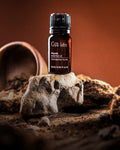

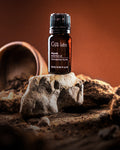
A desk diffuser routine works best when the same blend meets the same trigger every workday. Add 3 drops peppermint, 2 drops rosemary and 2 drops lemon per 100 ml of water, start the diffuser as you sit down, then begin your first task while it runs. Repeating that order, sit, fill, start, work, is what turns the aroma into a cue you recognize. Run it for 30 to 60 minutes at the start of a work block rather than all day, and skip it in rooms shared with pets, infants, or anyone sensitive to fragrance.
Why a Desk Diffuser Routine Needs a Trigger, Not Just a Blend
My desk gets worse in October. Something about the light going earlier makes me want to sort everything out, and then I sit down and don't actually start. I answer an email. I get up for coffee I didn't want. Forty minutes disappear.
That gap between sitting down and starting is the bit I've been trying to fix, and not with another app. I've tried enough apps. What's worked better is a much dumber thing: I switch on a diffuser.
Smell is wired a bit oddly compared to the other senses. It runs almost straight into the parts of the brain that deal with memory and emotion, which is why one particular smell can drop you into a room you haven't stood in for fifteen years. You can borrow that. Not in the sense that peppermint makes you clever. In the sense that if you smell the same thing every time you sit down to work, after a few weeks the smell starts to mean something.
So the diffuser isn't really the point. What matters is doing it in the same order each time. Sit, fill, start, work. The aroma is just the part you notice.
The 3-2-2 Focus Diffuser Blend
Per 100 ml of diffuser water:
• 3 drops peppermint essential oil
• 2 drops rosemary essential oil
• 2 drops lemon essential oil
Crisp, a bit herbal, citrus on top. I landed on 3-2-2 after a few weeks of the thing being too minty, so if peppermint is dominating your room, take it down to 2 and put the spare drop into lemon.
One warning from experience. The blend always smells weaker in the bottle than it does in the air, and if you correct for that by adding more oil you'll spend the next hour in a room that smells like a candy store. Start light. You can always add a drop tomorrow.
How Many Drops of Essential Oil for Your Diffuser Size
Most drop-count advice ignores tank size, which is why "5 drops" can be almost invisible in one room and far too much in another. Scale to your diffuser's water capacity first, then come down again if the room is small or has no window.
|
Diffuser tank |
Total drops |
3-2-2 blend split |
|
100 ml |
3–5 |
3 peppermint / 2 rosemary / 2 lemon (drop to 2/1/1 if it's strong) |
|
200–300 ml |
6–10 |
6 peppermint / 4 rosemary / 4 lemon, halve it for a closed room |
|
400–500 ml |
10–15 |
6 peppermint / 4 rosemary / 4 lemon, scale up only in a big or open-plan space |
Your diffuser's own manual beats this chart. Fill lines and recommended oil quantities vary quite a lot between models, so follow the manufacturer if the two disagree.
Essential Oils for Focus at a Desk
Peppermint
Peppermint is the one people notice when they walk in. It's sharp and cool and it lifts a room that's gone stale after three hours at the same screen. I use more of it before lunch and less after, mostly because by two o'clock I'd rather the room smelled quieter. It also mixes easily with citrus, so it rarely has to carry a blend on its own.
Rosemary
Rosemary nearly didn't make it in. On its own it's green and faintly medicinal and I don't especially like it. In a blend it earns its place, though, because it stops the other two smelling like a cleaning product. That's the honest reason it's here. It's also the one oil in this blend with a specific safety caution attached, so read that section before you commit to it.
Lemon
Lemon is the easy one. It brightens the top of the blend and takes the edge off peppermint, and on a gray morning it makes the room feel less like a Tuesday in November. If you want to browse other single oils to swap in, the essential oil singles collection lists aroma profiles for each.
For more variations on the same three oils, we've covered focus and productivity blends for a home office in more depth, and 8 DIY focus blends goes further into combinations.
How to Build the Diffuser Habit
Buying the oils is the easy part. Using them on the days you already feel organized is also the easy part, and it isn't a routine yet.
What works is bolting it onto something you already do without thinking about it:
1. Sit down at the desk.
2. Fill the diffuser and add the blend.
3. Open the laptop.
4. Write down the first task.
5. Start work while it runs.
You don't need a fixed clock time. If your day starts after breakfast, make the diffuser part of that handover. If you work afternoons, start it when you sit down for your main block. And if your schedule changes daily, pick an action rather than a time, like opening your project tool or starting your first writing task.
I'll admit the failure mode too, since it's a common one. Mine sat empty for about two weeks because refilling it had quietly turned into its own small chore, and I'd walk past it. Moving the bottle to sit right next to the diffuser fixed it. If your version of the habit keeps collapsing, the friction is usually something that small.
How Long to Diffuse During a Work Block
You don't need to run it all day, and I'd argue you shouldn't. Half an hour to an hour at the start of a block is plenty. Run it longer and your nose stops registering it, which defeats the whole idea, and you end up adding more oil to a room that already has enough in it.
Your device matters here more than people expect. Ultrasonic diffusers mix oil into water and push out a fine mist, so the aroma is lighter and tank size drives your drop count. Nebulizing diffusers atomize neat oil, so they throw out far more from far fewer drops and are better run in short bursts. A lot of them have an interval setting for exactly that reason. Numbers written for an ultrasonic model will be much too strong in a nebulizer.
Small room, no window? Start at the bottom of the range and air it out between sessions.
Desk Setup for a Focus Routine
I keep mine within sight but not within reach of the keyboard, so switching it on is a deliberate move rather than something my hand does while I'm reading email. Beyond that the list is short on purpose:
• A small diffuser, sitting away from the laptop, paper and any power strip
• The blend, capped, out of direct sun
• A notebook for the first task
• A lamp instead of the ceiling light
• Water
That's genuinely it. Every extra object on a desk becomes something to look at instead of working, and I've never once been helped by buying another desk accessory.
Diffuser or Roller at Work?
A diffuser changes the whole room, which is great when the room is yours and inconsiderate when it isn't. In a shared office a roller keeps the smell on you instead of in everyone's air.
If you make one, measure it rather than eyeballing it. For a 10 ml roller bottle:
• 1% dilution, about 3 drops of essential oil topped up with a carrier like jojoba or fractionated coconut. Fine for everyday use.
• 2% dilution, about 6 drops. Treat that as the practical ceiling for something you'll wear daily.
Keep lemon at or below 2% of the finished blend, or pick a steam-distilled lemon instead. Cold-pressed citrus oils, lemon included, can be phototoxic, meaning skin you've applied them to can react badly to sun or UV. Put a citrus roller somewhere that stays covered, or keep that patch of skin out of the sun for around 12 hours.
Never put essential oils on skin undiluted, and patch test anything new on a small area first.
Diffuser Safety in a Home or Shared Office
This is the section most desk-diffuser articles skip, and it's the one that actually decides whether any of the above is a good idea in your particular room.
Pets. Cats metabolize some of the compounds in essential oils poorly, and dogs can react too. Don't diffuse in a closed room with an animal in it, leave the door open so they can walk away, keep sessions short, and store bottles where they can't be knocked over. If you have a cat, the safest answer is simply not to diffuse in rooms they use.
Infants and young children. Peppermint and other menthol-heavy oils aren't recommended around babies and young children. Keep diffusion out of rooms where a small child spends time.
Rosemary. Rosemary is routinely cautioned in pregnancy and for anyone with epilepsy or seizure sensitivity, largely down to its camphor content. If that applies to you or to someone else in the room, leave it out and speak to your doctor first. Peppermint and lemon on their own still make a perfectly good two-oil version.
Asthma and fragrance sensitivity. Airborne aroma can be a trigger for some people. In a shared space, ask before you switch it on rather than after, start with fewer drops than you think you need, and turn it off if anyone would rather you didn't. A desk routine should fit the room it's in.
General handling. Keep oils out of reach of children and pets, store them capped and away from heat and sunlight, keep the diffuser back from the edge of the desk and away from electronics, and don't get any of it near your eyes.
If you want to go deeper than this, Essential Oil Safety by Robert Tisserand and Rodney Young is the reference people in the industry actually use. And if you're pregnant, managing a health condition or taking medication, ask a doctor or pharmacist rather than a blog.
These oils are used here for their aroma and sensory qualities. This article is for general information only. These statements have not been evaluated by the Food and Drug Administration. This product is not intended to diagnose, treat, cure, or prevent any disease.
An Autumn Variation on the Focus Blend
If you want the routine to feel seasonal rather than just happening to begin in September, change the top note. Swapping lemon for 2 drops of sweet orange gives you a rounder, warmer citrus that suits a four o'clock sunset, and the peppermint and rosemary underneath stay the same.
A single drop of clove bud or cinnamon bark will take it properly into autumn, but keep those two for diffusion only and go very easy. Both are strong skin sensitizers and have no business in a casual roller. One drop in a 100 ml tank really is enough, and I say that having once used two.
Final Thoughts
One blend, one diffuser, one action you repeat. That's the whole thing, and it's taken me longer to write about than it takes to do.
Start with 3-2-2, run it at the beginning of a work block, keep it light, and give it a few weeks before you decide whether it's doing anything. Check the safety notes against your own room first, especially if there's a cat or a small child in the house. At some point, switching it on stops being a thing you decided to do and just becomes the moment the work starts.