


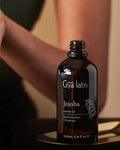

To make a cozy bath oil, combine 2 tablespoons of jojoba oil with 3 drops of lavender essential oil and 1 drop of Ylang Ylang essential oil. Mix well, then add about 1 teaspoon of the finished blend to a warm bath. Because bath oil can make the tub slippery, use caution when getting in and out and clean the tub after use.
There are evenings when I don't want another productivity hack, another screen, or another complicated self care routine. I just want the lights a little softer, the room a little warmer, and a bath that feels like an actual escape from the cold.
That's where hygge comes in.
The Danish idea of creating comfort through simple, cozy experiences has become one of my favorite ways to think about self care. And you don't need to completely redecorate your home to bring that feeling into your evening. Sometimes, a warm bath and a small bottle of homemade bath oil are enough.
This DIY bath oil combines jojoba oil with lavender and Ylang Ylang essential oils for a soft, floral aroma and a silky feeling addition to a chilly evening bath. It's simple to make, uses only a few ingredients, and turns an ordinary bath into something that feels a little more luxurious.
One important note before you start: oil and water don't mix. A bath oil can leave the tub and floor slippery, so take care getting in and out and clean the tub after use.
The Coziest Self Care Ritual
My favorite self care routines are the ones that don't feel like another task on my to do list.
A hygge inspired bath is exactly that kind of ritual. There's no complicated schedule to follow. You can warm up the bathroom, put on some quiet music, reach for a comfortable towel, and let the bath become a pause between the busy part of your day and the slower evening ahead.
The bath itself is only part of the experience. The aroma matters too.
Lavender brings a familiar soft, herbal floral scent, while Ylang Ylang adds a richer, slightly sweet floral note. Together, they create the kind of aroma I associate with cozy evenings rather than a bright, energizing morning. If you like this pairing, it also works beautifully in a diffuser, as in our DIY purple blend with lavender, Ylang Ylang and bergamot.
That's what I like about this blend. It doesn't try to do too much.
A small amount of essential oil bath oil can add aroma while the jojoba base leaves skin feeling conditioned after the bath. If your idea of hygge self care is less about elaborate routines and more about making ordinary moments feel special, this is an easy place to start.
And because you are making it yourself, you can adjust the aroma to suit your preference.
What You'll Need
You only need three ingredients to make this simple relaxing bath oil recipe.
· Jojoba oil: This is the carrier oil and the base of the blend. Jojoba has a lightweight feel and works well in many personal care formulations.
· Lavender essential oil: Lavender adds a soft, herbaceous floral aroma that works naturally in an evening bath.
· Ylang Ylang essential oil: Ylang Ylang brings a sweet, rich floral character that rounds out the lavender.
For one small batch, I recommend:
· 2 tablespoons jojoba oil
· 3 drops lavender essential oil
· 1 drop Ylang Ylang essential oil
That's enough to create a gently scented bath oil without making the recipe unnecessarily complicated.
If you're making this for the first time, resist the temptation to keep adding essential oils because the mixture smells subtle in the bottle. Essential oils are concentrated, and a little can go a long way.
How to Make the Bath Oil
Learning how to make bath oil at home is surprisingly straightforward. Here is the whole process, step by step.
1. Add 2 tablespoons of jojoba oil to a clean, dry glass bottle or small mixing container.
2. Add 3 drops of lavender essential oil and 1 drop of Ylang Ylang essential oil.
3. Cap the bottle and shake gently, or stir, until the ingredients are evenly combined.
4. Run a warm bath, then add about 1 teaspoon of the blend shortly before you get in.
5. Swirl the water gently with your hand and step in carefully.
6. After the bath, drain the tub and wash away any remaining oil residue.
That's it.
For a bath, begin with a small amount rather than pouring the entire mixture into the water. About 1 teaspoon is a sensible starting point for a standard bathtub. You can adjust the amount based on the size of your tub and how much aroma you prefer.
I like to add the oil shortly before getting into the bath, when the water is already at a comfortable temperature. Give the water a gentle swirl with your hand, then step in carefully.
Keep the rest of the blend in its bottle for your next bath rather than making a huge batch. Fresh, small batch blends are convenient and easier to store.
Lavender and Ylang Ylang
Lavender and Ylang Ylang are a particularly cozy pairing.
Lavender has a familiar clean, herbal floral aroma, while Ylang Ylang is fuller and sweeter. On their own, they have very different personalities. Together, they create a balanced floral blend that feels warm and inviting.
If you prefer a more understated aroma, keep the lavender slightly dominant. If you enjoy richer floral scents, you can experiment with the proportion of Ylang Ylang in future batches while keeping the overall essential oil concentration appropriately diluted.
This is also where personal preference matters.
I've found that bath blends don't need to smell strongly to make the experience feel special. In fact, I prefer a softer aroma that sits in the background while I relax rather than one that takes over the entire bathroom.
Dispersing vs Floating Oil
Here's an important detail that is easy to miss when making homemade bath oil.
Jojoba oil does not dissolve in bathwater. Instead, it disperses unevenly and can float on the surface of the water. That means the oil can come into contact with your skin in concentrated spots, and it can also make the bathtub slippery.
If you want a formulation where the essential oils are more evenly dispersed throughout the bathwater, you need a suitable bath dispersant or solubilizing ingredient designed for that purpose. Simply adding more carrier oil or stirring the water won't turn oil into a water soluble mixture.
For a straightforward DIY bath, I prefer keeping the recipe simple and treating it as an oil based bath addition rather than pretending the oil has dissolved into the water.
That distinction matters for both expectations and safety.
Bath Slip Safety
The coziest bath in the world isn't worth taking a tumble over.
Oil can make your bathtub surprisingly slippery, especially when it mixes with warm water and coats the surface. I recommend keeping a non slip bath mat nearby and taking your time when getting in and out.
Once you're finished, drain the tub and wash away any remaining oil residue. A quick clean is much easier than discovering a slippery bathtub the next morning.
There are a few other things I keep in mind whenever I make an essential oil bath blend:
· Keep the essential oils diluted. Don't add undiluted essential oils directly to bathwater. Mix them into the carrier oil first.
· Start small. You don't need a large quantity of oil for one bath.
· Patch test topical blends. If you're using the mixture on your skin rather than simply adding it to a bath, test a small amount on an inconspicuous area first.
· Be cautious with sensitive skin. If your skin is easily irritated, use a lower concentration and consider whether a plain carrier oil with no essential oils would be more appropriate for you.
· Avoid contact with eyes. Bath water containing essential oils should not be intentionally splashed into the eyes.
· Keep the bottle away from children and pets. Store your blend somewhere cool and secure.
And remember that essential oils are primarily used here for their aroma and sensory qualities. This bath oil isn't intended to diagnose, treat, cure or prevent any medical condition. For more on using oils in the tub safely, see our guide to essential oils for baths.
How to Make Your Bath Feel More Hygge
The bath oil is only the starting point.
If I'm creating a genuinely cozy evening, I like to think about the entire environment rather than just the product going into the bath.
Dim the overhead lighting. Put a clean towel within easy reach. Wear your softest robe afterward. Keep your phone somewhere you won't automatically reach for it.
You could also place a diffuser outside the bathroom with a gentle woodsy or floral blend, but keep the diffuser away from the tub and any water source.
The goal isn't perfection. It's creating an environment where you can slow down for a little while.
That's the part of hygge self care I enjoy most. It turns something ordinary into a small ritual. If you'd rather soak in salts than oil, our guide to Epsom salt baths covers that approach instead.
Final Thoughts
A good bath doesn't need to be complicated.
A little jojoba oil, a few drops of lavender and Ylang Ylang, warm water, and an hour without distractions can completely change the feeling of an ordinary evening.
That's what I like about this DIY bath oil. It isn't about creating a complicated homemade beauty formula. It's about making a familiar routine feel a little more intentional.
So the next time the weather turns chilly and you're craving some cozy comfort, make yourself a small bottle, run a warm bath, and give yourself permission to slow down.
Sometimes, the simplest rituals are the ones we actually look forward to.