



Face oil may be contributing to breakouts if you are using too much, choosing an oil that feels too rich for your skin, layering it in the wrong order, or introducing several new products at once. Reduce the amount to two or three drops, simplify the routine, patch test anything new, and give a change two to four weeks before you judge it.
Have you ever looked in the mirror and thought, why is my face oil breaking me out? I have.
Face oils can leave skin feeling soft and comfortable, so it is frustrating when the same bottle seems to turn on you. Before you decide face oils are not for you, look at how you are using it. The problem is often not the oil. It is the amount, the order, or the fact that three other things changed the same week.
Below are the six mistakes I see most, the routine I would rebuild from, and the dilution number that matters if you are adding essential oils to a facial blend.
Face Oil Is Not the Enemy
Using a face oil does not automatically mean breakouts.
Facial oils soften the feel of dry skin and add a smooth, emollient layer to a routine. The trick is choosing one that suits you and using less of it than you think.
When I first started with oils it was tempting to use several drops, because skin looks beautifully dewy immediately afterwards. It took me a while to notice that a much smaller amount gave me the same finish without the coated feeling an hour later.
So if your skin is unhappy, do not throw the bottle away yet. Start with the six habits below.
The Six Mistakes
1. Choosing an oil that does not suit your skin
Oils are not interchangeable. They differ in texture, in how fast they absorb and in how they feel four hours later. What one person calls perfect another calls greasy.
This is where the phrase non comedogenic usually appears, and it is worth being precise about it.
Non comedogenic is not a regulated term in the United States. No agency defines it, and no test is required before a product uses it on a label. Most of the comedogenicity ratings quoted online trace back to animal model assays run in the nineteen seventies and eighties, which is not the same as testing an oil on a human face. The term is a useful signal. It is not a promise, and no chart can tell you how your skin will respond.
If your skin tends to feel oily, you will probably prefer a lighter oil and a smaller amount. If it often feels tight, something richer may suit you better. Start from the texture you want rather than from whichever oil everyone is recommending this month, and remember that natural does not mean right for every face.
2. Using too much
This is the easiest mistake to make and the easiest to fix.
Face oil is concentrated. Two or three drops is enough to cover the face and neck in a thin layer. More than that can leave skin feeling greasy and can change how the rest of your routine sits on the surface.
Warm the drops between your fingertips, press or massage them over slightly damp skin, and give it a moment to settle. If you genuinely want more, add one drop. Starting low gives you far more control over the finish than starting high and hoping it absorbs.
3. Layering it in the wrong order
Even a well chosen oil can feel wrong in the wrong position.
The general rule is lightest and most water based first, heaviest and most oil based last. A full routine might run cleanser, then toner or an essence, then serum, then moisturiser, then face oil. You do not need every step. You just need to know where the oil goes.
Oil usually works best near the end, as the final emollient layer. There are exceptions depending on your products, but if something feels off, try moving the oil before you replace it.
A second option is to mix a drop or two into your moisturiser in your palm before applying. That gives a lighter finish if oil straight onto skin is not for you.
4. Skipping the patch test
Patch testing is the least interesting step in skincare and the easiest to skip.
Here is the version that actually takes two minutes. Put a small amount on the inner forearm or just behind the ear, leave it alone for 24 hours, and if nothing happens, repeat it on the same spot for two more days before putting it on your face. Skin sometimes reacts on the second or third exposure rather than the first, which is why one application is not really a test.
This matters most with essential oils. They are highly concentrated and should never go on the face undiluted. They belong in a carrier oil, at the percentage below.
A patch test is not a guarantee that nothing will ever happen. It is still the sensible first step with anything new.
5. Introducing several new products at once
Imagine starting a new cleanser, serum, oil, exfoliant and moisturiser in the same week, and then your skin changes. Which one did it?
You will never know, and you will probably blame the oil because it is the newest sounding thing in the routine.
Change one product at a time and keep everything else familiar. It is slower and it is the only way to learn what your skin actually likes. It also keeps the routine from quietly growing to eleven steps.
6. Ignoring how your skin actually feels
Sometimes we get so focused on finding the right product that we stop listening to the obvious.
If an oil consistently leaves your face feeling greasy, uncomfortable or congested, you do not have to keep using it because the reviews are good. Try less of it. Then try it less often. If nothing changes, switch to a lighter texture.
A routine you tolerate is not a routine you will keep.
How to Use Face Oil Correctly
If you are rebuilding from scratch, this is the order I would start with.
The routine, step by step
Start with clean skin
Wash with your usual cleanser and pat dry. You are not trying to strip the skin until it squeaks. You are just starting from a fresh surface.
Apply your lighter products first
Toner, essence or serum go on before the oil. Let each one settle rather than stacking three layers in twenty seconds.
Use two or three drops
Warm them between your fingertips and press or massage them gently over the face. Avoid rubbing hard. If your skin still feels tight and you want more, add one drop.
Finish with intention
For most routines the oil sits last because of its texture. If you already use a moisturiser, the oil goes on top, or a drop or two can be mixed into the moisturiser in your palm instead. Which one you prefer depends on your products and the finish you like.
Give it two to four weeks
Do not judge an oil by how your skin looks five minutes after applying it. Skin turns over on a roughly four week cycle, so give a new product at least two weeks, and closer to four before you decide it is not working. A beautiful immediate glow is not the goal. Comfortable skin a day later is.
If Your Face Oil Is Breaking You Out
First, stop and simplify. Go back to the products you already know suit you, and let your skin settle before you reassess anything.
Then work through the list:
• Did I use more than two or three drops?
• Did I start another new product in the same week?
• Was the texture heavier than what my skin usually likes?
• Did I use an essential oil without diluting it?
• Did I skip the patch test?
• Was I layering it with products that do not sit well together?
These questions get you to a cause. Assuming every face oil will do the same thing does not.
If a product consistently does not suit you, there is no prize for persevering. Try a different texture or simplify further. And if you notice a change in your skin that is distressing or does not settle, talk to a licensed health professional rather than working through it alone.
Diluting Essential Oils for Facial Use
If you are adding essential oils to a carrier rather than using a plain facial oil, the face has its own number.
Facial applications sit at 0.5 to 1 percent, against 1 to 2 percent for the body. In a 30ml bottle of carrier oil that is 3 to 6 drops of essential oil in total, not per oil. In a 10ml bottle it is 1 to 2 drops.
Work out the percentage rather than counting drops and hoping. Our step by step guide to diluting essential oils has the ratios for larger batches.
One more thing if you are using citrus oils in a morning blend. Several of them are phototoxic, which means skin that meets sunlight within about twelve hours of application can burn or darken. Our guide to citrus oils and sun sensitivity lists which ones.
The carrier oil is doing most of the work on texture. The essential oil is mostly there for aroma, and at 1 percent it is a very small part of the bottle.
Choosing a Carrier Oil
There is no single best facial oil, only the one whose texture suits you. Start from how you want it to feel.
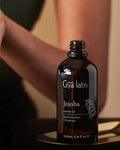
Organic Jojoba Oil, $14.99 for 100ml, is the one I reach for most. It is Simmondsia chinensis, cold pressed from the seed in Arizona and Mexico, and it is technically a liquid wax rather than an oil, which is why it feels lighter on skin than its price per ml suggests.
Organic Rosehip Oil, $15.99 for 30ml, is a common choice in facial blends and has a light, fast absorbing feel. The smaller bottle suits face only use, since a 100ml bottle of anything you use three drops of at a time will outlive its freshness.
Organic Argan Oil, $16.99 for 100ml, is cold pressed from Moroccan kernels and sits slightly richer than jojoba. Worth trying if your skin often feels tight.
The full range is in the carrier oils collection. If you are choosing between two, pick the lighter one first. It is easier to add richness to a routine than to take it away.
A Simple Routine That Works
When I do not want to think about it, my evening routine is four lines long.
Cleanse. Light moisturiser. Two drops of oil. Then leave my skin alone.
That last part matters more than people expect. Constant touching, layering and reapplying gives skin nothing to settle into. Two or three well spread drops of jojoba give a comfortable finish, and doubling that does not make it twice as good.
That is the real takeaway from all six mistakes. A routine does not have to be complicated to work.
Final Thoughts
A face oil does not have to be the reason your routine is not working.
Usually it comes down to using too much, choosing a texture that is heavier than your skin likes, layering it in an awkward order, or changing four things at once and having no way to tell which one mattered.
Start with two drops. Choose the oil on texture rather than on a chart. Add one new product at a time, give it a month, and pay attention to how your skin feels the next morning rather than five minutes after you apply it. If you are still deciding where to start, the lighter end of the carrier oils range is the easiest place.
Fewer products, sensible amounts, and enough flexibility to change your mind. That is what makes a routine last.