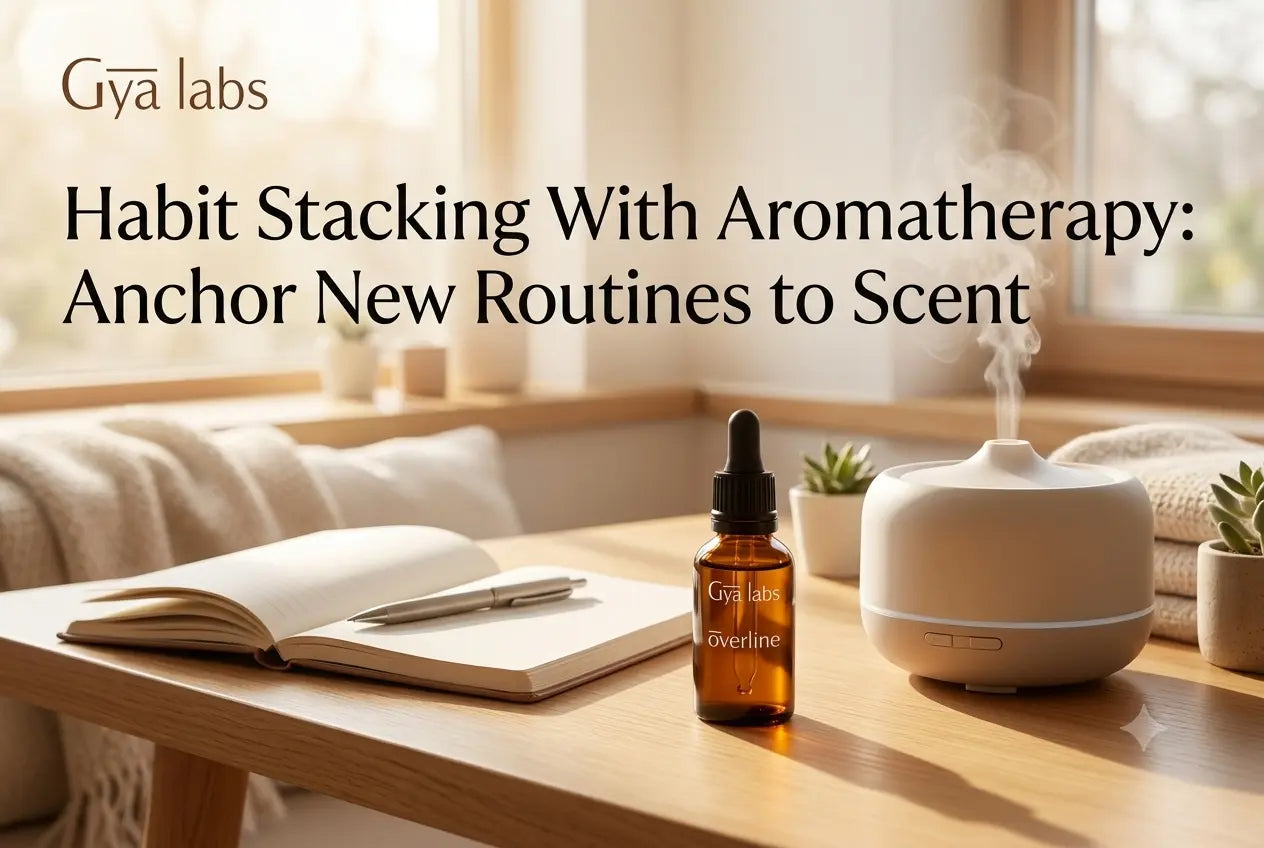




Habit stacking with aromatherapy means pairing a familiar scent with an existing routine to create a consistent cue for a new habit. For example, you can use lemon essential oil during your morning planning, peppermint essential oil when starting focused work, or frankincense essential oil as part of your evening wind-down. The scent does not create the habit on its own; repeating the same aroma alongside the same behavior can make the routine feel more recognizable and intentional.
Starting a new habit sounds easy until real life gets in the way. You plan to meditate every morning, focus better at work, journal before bed, or finally remember to stretch, and then suddenly two weeks have passed.
I've found that the problem usually isn't knowing what I want to do. It's remembering to do it consistently.
That's where habit stacking can help. Instead of trying to build a completely new routine from scratch, you attach a new behavior to something you already do. Add scent to that process, and you have another memorable cue that can help signal, "It's time for this."
The idea isn't that an essential oil magically creates a habit. Rather, scent and habits can work together as part of a repeatable routine. A familiar aroma can become associated with a particular activity, making it easier to recognize that it's time to begin.
Think of it as creating a tiny ritual around the habits you want to keep.
Why Scent Is a Powerful Habit Cue
We tend to think of scent as something that simply makes a room smell nice.
But smell can be surprisingly tied to memory and emotion.
A particular perfume can remind you of someone. The smell of freshly brewed coffee can make you think of mornings. A certain sunscreen can instantly transport you back to a beach vacation.
That's the interesting part about scent memory.
When you repeatedly experience the same scent in the same context, that aroma can become part of the memory associated with that moment. You can use this idea practically by choosing one scent for a particular routine and using it consistently.
For example, imagine using peppermint every time you sit down to work.
At first, you're simply diffusing peppermint because you enjoy its crisp aroma. After repeating the same sequence over time, the scent becomes part of your work ritual.
Peppermint goes on.
Laptop opens.
The phone goes away.
Work begins.
The scent isn't doing the work for you. It's becoming one part of the cue that tells you what comes next.
That's the distinction I always keep in mind when working with aromatherapy. We're not trying to make exaggerated promises about what an essential oil can do. We're creating a familiar environment around a behavior we already want to practice.
For more ideas on using aroma intentionally, Gya Labs' Aromatherapy for Emotions resource is a useful place to explore different scent profiles and moods.
Habit Stacking, Explained
So, what exactly is habit stacking?
The concept is simple: connect a new habit to an existing habit or routine.
Instead of saying:
"I'll start journaling every night."
You create a sequence:
"After I brush my teeth, I'll journal for five minutes."
The existing habit acts as the trigger for the new one.
Aromatherapy can become an additional sensory cue within that sequence.
For example:
Existing habit: Make morning coffee
New habit: Five minutes of journaling
Scent cue: Lemon essential oil
Or:
Existing habit: Sit down at your desk
New habit: Start a focused work session
Scent cue: Peppermint essential oil
Or:
Existing habit: Turn off your laptop
New habit: Begin an evening wind-down
Scent cue: Frankincense essential oil
This is what makes aromatherapy for habits so practical. This is not an entire new wellness routine you are tacking on, this is in fact enhancing something you are already doing with the addition of scent.
And because the routine remains simple, there's less to remember.
Pick a Scent for Each Routine
If you're new to essential oils for routine, don't start by buying ten different oils.
Start with one.
Choose a scent that fits the routine you're trying to establish and use it consistently.
I like dividing routines into three broad parts of the day:
-
Morning start
-
Focus or work
-
Evening wind-down
Each can have its own scent identity.
Morning Start Cue
Mornings can feel chaotic.
The alarm goes off. Your phone starts buzzing. You're thinking about emails before you've even left the bed.
A bright citrus aroma can help make the beginning of the day feel more intentional.
For this type of ritual, I particularly like lemon.
Lemon has a crisp, bright aroma that works naturally in morning spaces.
Here's how I'd use it:
Get out of bed.
Open the curtain.
Turn on the diffuser.
Make a morning coffee (or tea).
Take 5 minutes and map out the day.
That's your 'morning stack'.
What's crucial isn’t so much the lemon oil, in this instance; it's the consistent order of actions.
Eventually, the scent becomes associated with the beginning of that routine.
You could also use a personal inhalation method appropriate for your product and follow the manufacturer's directions rather than making the routine unnecessarily elaborate.
Focus / Work Cue
This is probably my favorite application of scent anchoring for habits.
Work already has plenty of distractions. Your phone is nearby, notifications are popping up, and there is always another tab you could open.
I prefer creating a clear beginning to a focused work session.
My sequence would look something like this:
Sit at the desk.
Clear unnecessary tabs.
Put the phone away.
Start the diffuser.
Begin the first task.
Peppermint is an obvious choice here because of its crisp, refreshing aroma.
You can think of peppermint as the scent associated with "work mode."
Again, I wouldn't say that peppermint makes you focus. That's too simplistic.
Instead, you're creating a repeated sensory association around the act of focusing.
Over time, the sequence itself becomes familiar.
Evening Wind-Down Cue
The evening routine needs a completely different personality.
If your morning scent is bright and energetic, your evening aroma can be warmer and more grounding.
Frankincense is one of my favorite options for this.
Its rich, resinous aroma works beautifully in an evening environment.
Try this sequence:
Shut the laptop lid.
Turn the lights low.
Turn the diffuser on.
Put your phone on Do Not Disturb mode.
Read for, journal for, stretch for, or just sit for a few minutes.
There is no need to overcomplicate the process.
It's to give your brain a recognizable transition from "the day is still happening" to "I'm winding down now."
Make the Cue Stick
Choosing a scent is the easy part.
Using it consistently is where the real work happens.
I've seen people create beautiful aromatherapy routines that last approximately four days.
Then the diffuser disappears into a cupboard.
Don't do that.
If you want a scent to become part of a habit, make the setup almost ridiculously easy.
Keep your diffuser somewhere visible.
Keep the oil beside it.
Choose a routine you already perform every day.
Then repeat the same sequence.
Start With One Habit
Don't try to completely redesign your life on Monday morning.
Choose just one behavior.
It might be 10 minutes of reading.
It might be journaling.
It might be planning tomorrow’s tasks.
It might be a short screen break.
Link that behavior to an established habit and add your trigger smell. Once that behavior is automatic, you build the next stack.
Keep the Scent Consistent
This association becomes more vague if it's peppermint as a work scent one day, lavender the next, citrus after.
It's perfectly fine to like more than one oil!
But if you're intentionally experimenting with scent anchoring for habits, consistency is useful.
Give one scent one job.
Lemon can mean "morning."
Peppermint can mean "focus."
Frankincense can mean "wind-down."
That makes the routine easy to remember.
Don't Make the Habit Too Big
This is where I think many people go wrong.
They decide their new habit needs to be thirty minutes long.
It doesn't.
Start with five minutes.
If your goal is reading, read two pages.
If your goal is journaling, write three sentences.
If your goal is meditation, sit quietly for two minutes.
The goal initially is not to prove how disciplined you are.
It's to establish the connection between the cue and the behavior.
Use the Same Order
The sequence matters.
For example:
Peppermint → desk → phone away → open task list → work
Do that repeatedly.
The scent becomes one part of the sequence rather than a random addition.
Diffuser or Roller for Habit Cues?
Both can work, but they suit different situations.
A diffuser makes sense when the habit happens in one place.
If your morning routine happens in the bedroom, use your diffuser there. If your work routine happens at your desk, keep the diffuser nearby.
A roller can be more convenient when you want a personal aroma cue without scenting an entire room.
For example, you might use a properly formulated aromatherapy roll-on as part of a pre-work routine.
The important thing isn't which format is objectively better.
It's which one you'll actually use consistently.
If setting up a diffuser feels like too much effort every morning, it probably isn't the right cue for your routine.
How Long Until a Scent Cue Works?
There's no universal number of days after which a particular scent suddenly becomes a habit cue.
Habit formation varies depending on the behavior, the individual, and how consistently the routine is repeated.
That's why I wouldn't obsess over a specific timeline.
Instead, pay attention to repetition.
If you use the same aroma before the same activity again and again, you're giving yourself the opportunity to build an association between them.
And if you miss a day?
Don't throw away the whole routine.
Just start again the next day.
One missed morning doesn't erase your progress.
Can Different Scents Represent Different Habits?
Absolutely.
In fact, this can be one of the most enjoyable parts of building a scent-based routine.
You can even map out your personal scents!
Lemon: For my early morning planning sessions
Peppermint: Focused work
Frankincense: During challenging tasks or focused work
The important thing is to keep each association clear.
You don't need to use a different oil for every tiny task.
Three distinct cues are more than enough for a beginner.
Over time, you may discover that certain aromas naturally fit particular activities for you.
That's where personal scent memory becomes especially interesting. An aroma that means "Sunday morning" to one person might mean "late-night studying" to another.
There isn't necessarily a right answer.
It is important to build upon your own associations.
A Simple Starter Routine
If you want to try aromatherapy for habits without overcomplicating it, start with one routine.
Here's the one I'd recommend.
The Five-Minute Morning Stack
Existing habit: Morning coffee or tea
Scent: Lemon
New habit: Five-minute planning session
Start your diffuser with lemon while preparing your drink.
Sit down with a notebook.
Write down the three things that matter most that day.
That's it.
Don't create a forty-minute morning routine.
Don't add meditation, yoga, journaling, cold showers, reading, affirmations, and twelve supplements all at once.
Five minutes is enough to start.
Once the sequence becomes familiar, you can expand it if you want.
A Focus Routine for Work
For a work-focused ritual, try peppermint.
Sit down at your workspace.
Start the diffuser.
Put your phone somewhere out of reach.
Choose one task.
Work on it for a predetermined period.
When you're finished, turn off the diffuser.
That last step is useful because it gives the routine a clear beginning and ending.
The goal is to create a small environmental signal around your work session.
And if you're someone who works from home, this can be particularly helpful because home and work can otherwise blur together.
An Evening Wind-Down Routine
For the evening, I'd reach for frankincense.
Once your workday is finished, turn off the computer and start your diffuser.
Dim the lights.
Put your phone aside.
Then choose one quiet activity.
Read.
Journal.
Stretch.
Listen to music.
Or do absolutely nothing.
That's allowed too.
The aroma becomes part of the transition.
You're not asking the oil to force you to relax. You're simply creating a consistent sensory environment around your wind-down habit.
Safety Tips for Using Aromatherapy in Your Routine
A habit may be repeated frequently, so safety matters even more when you're using essential oils regularly.
Essential oils are highly concentrated. Follow the directions supplied with the specific product and use appropriate dilution for topical applications.
If you're making a roller or another skin-care product, dilute essential oils in a suitable carrier oil rather than applying them undiluted.
Patch test new topical blends before broader use.
For diffusion, follow your diffuser manufacturer's instructions and use an appropriate amount of essential oil.
It's also important to remember that some essential oils have additional safety considerations, including photosensitivity or restrictions for certain individuals.
If you're pregnant, nursing, taking medications, managing a health condition, or considering aromatherapy for a child or pet, speak with an appropriately qualified healthcare professional before use.
Most importantly, keep your expectations realistic.
Aromatherapy can be a lovely addition to a routine, but it shouldn't be presented as a treatment for medical or psychological conditions.
Final Thoughts
The best thing about habit stacking is that it doesn't require you to become a completely different person overnight.
You simply take something you're already doing and attach one small behavior to it.
Adding scent gives that sequence another sensory layer.
Maybe lemon becomes your signal for starting the morning.
Maybe peppermint becomes your cue for sitting down and getting focused.
Maybe frankincense becomes part of your transition into the evening.
The oils aren't responsible for your habits.
You are.
The scent simply becomes part of the ritual.
And sometimes, having one small, familiar cue is enough to make a routine feel easier to begin.